![[blog] haltman.io](/_next/image?url=https%3A%2F%2Fcdn.hashnode.com%2Fres%2Fhashnode%2Fimage%2Fupload%2Fv1768034916251%2Fd87965ea-5f25-4bb8-a3f5-1bd64c4841fb.png&w=1080&q=75)
![[blog] haltman.io](/_next/image?url=https%3A%2F%2Fcdn.hashnode.com%2Fres%2Fhashnode%2Fimage%2Fupload%2Fv1768035074177%2F336f82b5-521c-41ae-9a59-7ffbd9dc27b0.png&w=1080&q=75)
ip.thc.org - a “Censys/Shodan” for the world of domains (5.14 billion records)
A massive reverse-DNS, subdomain and CNAME intelligence platform indexing over 5.14 billion domains
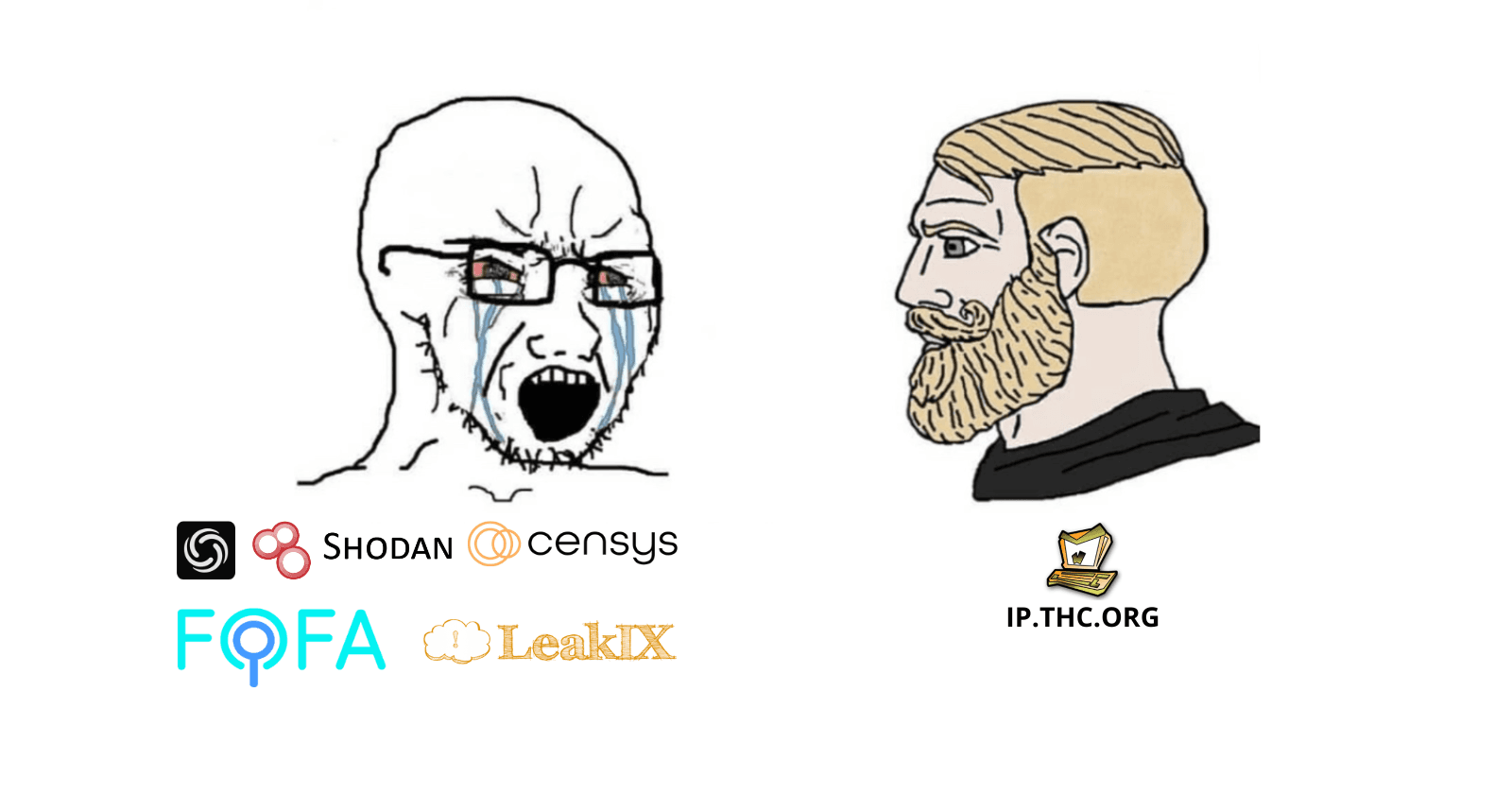
The technical OSINT ecosystem has matured around infrastructure “search engines” (Shodan, Censys, Fofa): you query a target and pivot by banners, certificates, ports, services, fingerprints. IP.THC.ORG, a new project from The Hacker’s Choice (THC), takes a different approach: the massive relationship between IPs and names (rDNS), subdomains, and CNAMEs, with a very pragmatic proposal: CLI-first, simple endpoints, monthly bulk data, and a dataset that already has 5.14 billion records.
Why does this matter?
Because in investigation and Attack Surface Management, “name ↔ IP ↔ DNS records” is the glue that enables attribution, pivoting, and exposure detection, even before we talk about ports and banners.

What is ip.thc.org, in practice
Think of ip.thc.org as a giant index for answering questions such as:
“Which hostnames perform reverse DNS for this IP?” (infrastructure pivot)
“What subdomains exist for this apex domain?” (surface mapping)
“What domains point (CNAME) to this target?” (detection of dependencies and possible takeovers)
The most interesting part is that it comes with three layers of consumption:
CLI-friendly via cURL, with colored output and useful headers
REST API (JSON) + CSV downloads for integration into pipelines
Monthly bulk data (CSV/Parquet) for offline analysis at scale (DuckDB recommended)
And, on the “sources and intake” side, the project documentation explains that rDNS is “powered by” Segfault, Domainsproject, and CertStream-Domains.

Numbers and distribution of the dataset (what you can download)
The Bulk Data Access doc publishes clear and useful statistics for planning:
Last updated: January 2, 2026
Date for: December 2025
Records: 5.14 billion
Size (compressed): Parquet ~40GB / CSV ~30GB
Size (uncompressed): Parquet ~60GB / CSV ~190GB
The model is: a complete dump at the end of each month, with direct download links (CSV and Parquet).

Layer 1: CLI-friendly (cURL) — fast, auditable, scriptable
1) rDNS: IP → hostnames
Direct example (limiting return):
curl 'https://ip.thc.org/1.1.1.1?l=10'
You get useful context in the header (ASN, org, approximate geo) and then the list of entries. The doc itself shows rate limit and filter options.

2) Subdomain lookup: apex → subdomains
curl 'https://ip.thc.org/sb/wikipedia.org?l=20'
In the documentation, the subdomain endpoint also has a rate limit and suggests pivots (e.g., go to CNAME lookup).
3) CNAME lookup: target → domains that point to it
curl 'https://ip.thc.org/cn/github.io?l=20'
Useful for discovering dependencies, frontdoors, and even takeover hypotheses (always validating with provider rules and the actual status of the resource).

Layer 2: API (JSON) and CSV downloads — integration into pipelines
The CLI-friendly documentation also lists API endpoints that you can put directly into automations (SOAR, enrichers, ETL, etc.):
Lookup by IP (includes /24, /16, /8 blocks)
curl 'https://ip.thc.org/api/v1/lookup' \
  -X POST \
  -d '{ "ip_address":"1.1.1.0/24", "limit": 10 }' -s
Subdomain lookup by domain
curl 'https://ip.thc.org/api/v1/lookup/subdomains' \
  -X POST \
  -d '{ "domain":"github.com", "limit": 10 }' -s
CNAME lookup by target
curl 'https://ip.thc.org/api/v1/lookup/cnames' \
  -X POST \
  -d '{ "target_domain":"google.com", "limit": 10 }' -s
And when you want something that fits into a spreadsheet/SIEM/grep, there are CSV download endpoints with a high limit (up to 50k) and an option to hide the header.

Layer 3: Bulk data (Parquet/CSV) — “build your own engine”
If you want scale, the route is to download the monthly dump and query locally. The project itself recommends DuckDB and gives a direct query example in Parquet:
duckdb
select * from 'rdns.parquet' where ip_address='1.1.1.1' limit 10;
This opens the door to:
internal enrichment (Threat Intel / ASM)
historical analysis by month
indexing in ClickHouse/Elastic/OpenSearch
correlation with CT logs / passive DNS / proxy logs / EDR
“Where does this come from?” (public clues on the trail)
Two pieces of the ecosystem help to understand the type of intake/expansion of the project:
The old CertStream-Domains repository (daily dumps of domains observed in certificate transparency) was archived with the note that THC “stepped up to overtake & expand the data”, and points to cs1/cs2 as the source of the daily dumps.
The dnsstream utility (from THC itself) captures DNS traffic and “displays the answers,” explicitly described as “part of the ip.thc.org project.”
This alone does not “prove” the entire internal pipeline (nor should it—opsec and abuse exist), but it does indicate a coherent design: aggregation + continuous observation + publication.

Real use cases (where it shines)
1) Infrastructure pivoting (IR / Threat Intel)
You start with a suspicious IP (IOC), extract rDNS, cross-reference with subdomains and CNAME, and arrive at:
exposed frontends / administrative areas
“forgotten” domains pointing to old infrastructure
third-party dependencies (CDN, storage, PaaS)
2) Attack Surface Management (ASM) without relying on heavy scanners
Before scanning ports, you build a list of hostnames/subdomains and prioritize:
patterns like “dev, staging, admin, old, beta”
newly discovered assets (when combined with daily/monthly datasets)
3) Hunting for dangling CNAME / misconfig
CNAME lookup helps answer “who points to X?” and “which domains depend on a target.” This speeds up screening in bug bounty programs — with responsible validation.
Rate limiting, ethics, and best practices
The example responses themselves show rate limiting (e.g., “You can make 249 requests... replenishes at 0.50/sec”), so treat it as a public service: local cache, backoff, and bulk data when you need volume.
And the THC context also matters: the group has a historical culture of research/hacking “without trying to get rich,” with a strong community and tooling bias.
Conclusion: where ip.thc.org fits into your stack
If Shodan/Censys are “service search engines,” ip.thc.org is the foundation block for name intelligence:
fast for pivots (CLI)
integrable (API/CSV)
scalable (monthly Parquet + DuckDB)
In 2026, with 5.14B records published and a very objective distribution model, it is worth adding ip.thc.org to your OSINT kit — especially if you work with ASM, Threat Intel, IR, or responsible offensive research.